
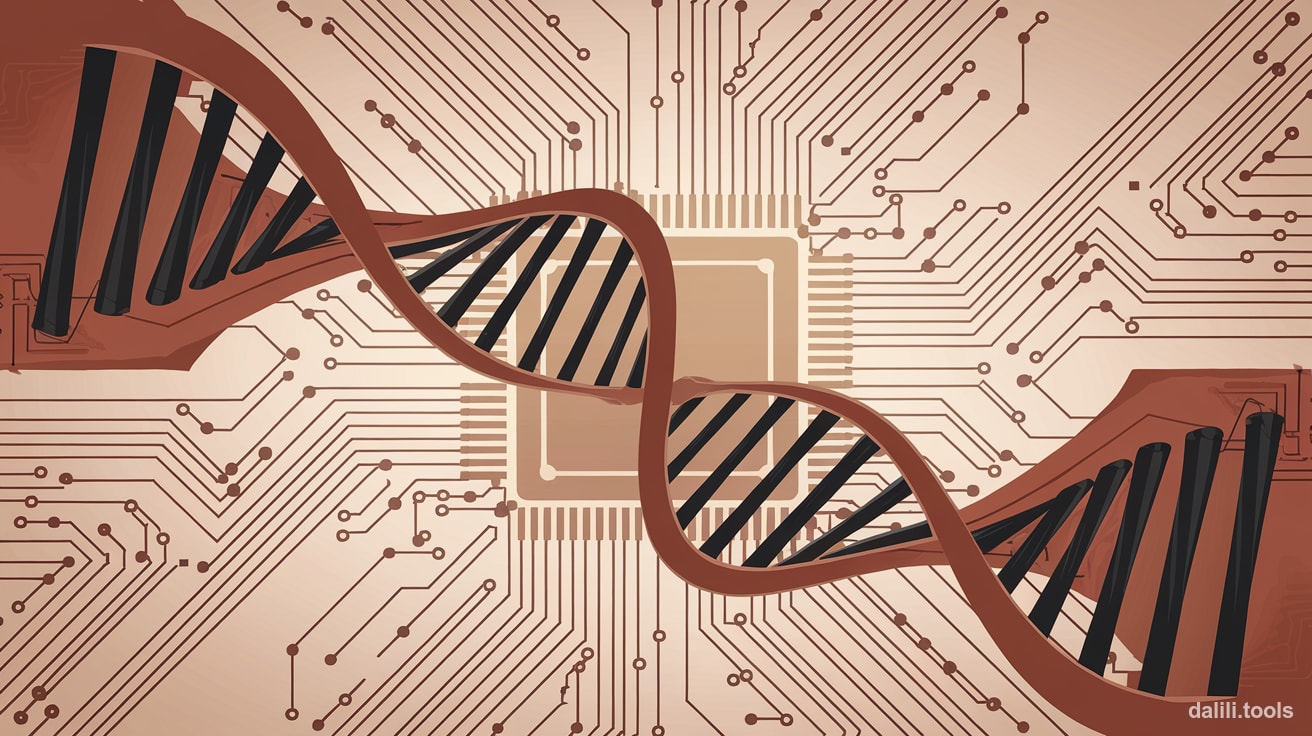
A research team at Penn State, working with the University of Minnesota, engineered a memristor that combines chemically customized synthetic DNA with a crystalline perovskite semiconductor, creating a bio-hybrid memory device that operates at less than one-tenth of standard voltage levels. The findings were published in the journal Advanced Functional Materials on January 19. A memristor stores and processes information in the same physical location and retains the direction of prior current flow even after power is switched off, a structure that mimics how neurons function in the brain rather than the separated storage-and-processing layout of conventional computer memory.
The team applied silver nanoparticles to short, custom-engineered DNA sequences through a process called doping, making the DNA conduct electricity while also orienting its molecular units in a more streamlined arrangement. Integrated with thin films of crystalline perovskite, the combination produced highly efficient conductive channels. DNA on its own is an extraordinarily dense information carrier, with a single gram capable of holding roughly 215 million gigabytes, and researchers see combining that density with electronic function as a path toward memory hardware that supports far more efficient data centers and next-generation computing.
Co-corresponding author Kavya S. Keremane, a postdoctoral researcher in materials science and engineering at Penn State, said bridging biology and electronics required building an entirely new materials platform for the two fields to function together. The work, which has a patent application underway, was supported by the US National Science Foundation and the National Institutes of Health. As AI systems and data centers consume rapidly growing volumes of DRAM, NAND flash, and high-bandwidth memory, researchers frame DNA-based bio-hybrid memory as a potential long-term route toward neuromorphic computing hardware.